Introduction
There’s a simple truth in heavy industry: if the origin of the steel is uncertain, nothing built from it can be trusted. And yet, many buyers still assume that a forging supplier’s certificates tell the full story. They don’t. Traceability and heat-treatment integrity aren’t about glossy paperwork — they’re about how honestly the company handles steel from the minute it enters the yard to the moment the finished part leaves the gate. That’s where most suppliers reveal their discipline, or the lack of it.
The following guide breaks down exactly how to check whether steel forging companies are genuinely reliable or just pretending.
Start With the Steel, Not the Story
The first sign of a serious forging operation is visible right on the raw steel. Every bar or billet should carry a heat number that hasn’t been scribbled with a marker at the last moment. It should be stamped or engraved from day one. If the number looks too fresh, or if different pieces from the same batch show mismatched markings, something is off.
A buyer doesn’t need a metallurgical degree to notice sloppy storage. Mixed piles, fading tags, rusted plates with illegible IDs — all of these suggest a supplier that treats traceability like an afterthought. Good steel forging companies guard their heat numbers the way banks guard currency serial codes.
Only after visually confirming physical identity does it make sense to ask for the MTC (mill test certificate). The numbers on the MTC must match the markings on the steel — not “almost match,” not “match after they rewrite it” — exactly match, character for character. Genuine suppliers never get defensive when asked to show certificates for multiple heats. The defensive ones usually have something to hide.
Watch the Movement of Steel on the Shop Floor
Traceability collapses the moment materials start mixing. That’s why reputable forging plants separate each heat like a different currency. A heat meant for automotive doesn’t touch the racks meant for oil & gas, and neither goes near aerospace-grade raw stock.
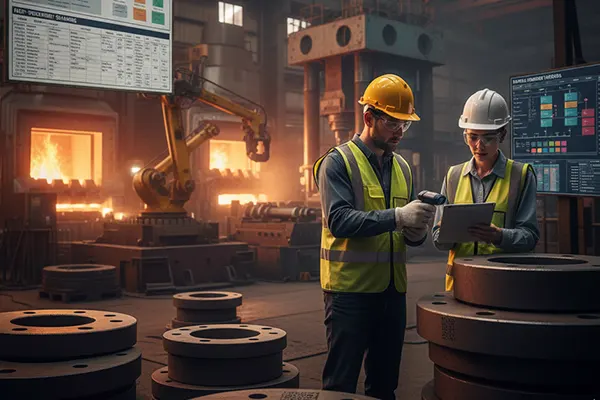
During a visit or audit, observe the internal workflow. Heat trays, bins, and trolleys must be marked clearly. Workers should know which batch they’re handling without pausing to ask. Random movement and “temporary mixing” of billets is a sign that the company hasn’t internalized basic traceability discipline.
When reviewing the company’s ERP or tracking logs, look for something simple: timestamps. Processes that are truly traceable show a clear movement pattern — incoming check, cutting, forging, heat treatment, testing, dispatch. If there are gaps in the timeline or sudden jumps between stages, the system isn’t as airtight as it should be.
Study the Heat-Treatment Area Like a Crime Scene
Heat treatment is where the soul of the steel gets shaped. Every forged part acquires its strength, toughness, and life expectancy here. Any inconsistency in heating, holding, quenching, or tempering will show up months or years later as failures, cracks, or deformation.
An honest forging shop never hides this area. Furnaces are calibrated. Logbooks aren’t “updated later.” Batch cards are filled in real-time. Temperature curves don’t look suspiciously perfect. Real industrial data always has minor fluctuations — temperature dips when the door opens, slight variations across different furnace zones. Uniformly flat data is usually a sign of creative reporting.
Companies that take heat treatment seriously will also run post-treatment hardness tests, microstructure checks, and sample cuts. These test results should be tied to the same heat numbers used earlier. If a plant produces heat-treated parts but rarely performs microstructure work, they're operating on guesswork, not engineering.
Non-Destructive Testing Reveals the Company’s Honesty
Ultrasonic testing, magnetic particle checks, and dye penetrant inspection aren’t optional. They’re the last line of defense. The way forging suppliers conduct NDT says a lot about their integrity.
Shops that rush through UT or perform MPI in poor lighting generally don’t care about quality. Meanwhile, competent steel forging companies run NDT like a medical diagnostic lab — quiet, methodical, documented. Every test report carries the date, operator signature, equipment ID, and the exact heat number.
Pay attention to rejections. A supplier that claims “near-zero rejections for years” isn’t proud — they’re suspicious. Real-world forging environments produce occasional defects. Anyone pretending otherwise is either skipping tests or altering records.
Documentation Should Feel Boringly Strict
The strongest forging suppliers don’t impress with fancy presentations. Their strength lies in how standardized and painfully consistent their documentation looks.
Check for:
- Heat numbers repeated across every document
- Batch IDs that match physical markings
- Hardness charts attached to heat-treated lots
- NDT reports tied to the same identification code
- Dimensional inspection reports showing actual readings, not rounded figures
A sloppy or over-polished certificate is a warning sign. Real paperwork in industrial environments looks lived-in — multiple signatures, stamps, minor pen marks, and naturally varied formatting. Not the copy-pasted perfection of a company hiding internal disorder.
Benchmark Their Process Against Industry Reality
Standards exist for a reason. They define the minimum acceptable discipline. That’s why buyers should quietly compare the company’s workflow with widely used industrial norms — raw-material handling, heat-treatment procedures, NDT acceptance criteria, and record-keeping formats. Reputable shops don’t improvise these processes. They follow a structure because they know their output is only as strong as the chain of standards behind it.
If a company claims to follow high-integrity standards but cannot produce calibration logs or doesn’t allow furnace records to be reviewed, that inconsistency speaks louder than any marketing claim.
Do a Ground-Reality Audit Instead of a Ceremony Visit
Some suppliers rehearse their audits. A smart buyer surprises them. Walk into wrong corners of the shop deliberately. Pick random forgings and ask what heat they belong to. Point to a batch on the side and request the associated documentation. Cross-check NDT logs against physical markings. In strong forging shops, employees don’t panic when this happens — they reach for the records confidently because the system protects them.
Weak suppliers, on the other hand, scramble, guess, delay, or “go find the right folder.” That’s when the truth comes out.
The Real Difference Between a Good Forging Company and a Pretender
Traceability is not a certificate. It’s a culture.
Heat treatment is not a furnace cycle. It’s a responsibility.
And steel forging companies that understand these truths never struggle to prove their transparency.
What separates trustworthy suppliers from risky ones is simple:
- Raw steel never loses its identity.
- Heat-treatment logs match physical batches.
- NDT results are honest, even when the truth isn’t flattering.
- Every document connects back to a single, verifiable origin.
When these elements align, the forging supplier isn’t just producing ss forging parts — they’re producing reliability.
Conclusion
In the end, choosing a forging partner in India isn’t about fancy brochures or big promises — it’s about who can consistently deliver parts that hold up under real-world stress. The companies that matter are the ones where the machines never stop, the quality logs are honest, and every batch tells the same story of discipline and precision. If there’s one rule to trust, it’s this: judge a forging company by the parts that survive in the field, not the claims printed on their website. That simple filter saves money, time, and a lot of unnecessary headaches.

